Cognitive Poetics
Research Group
Man as a cultural being constitutes the traditional subject of humanities. However, the cultural studies scholarship , which has been gaining momentum since the 1990s, often overemphasizes the culture-dependent and relative nature of human behaviour, and is sometimes biased towards the exclusivity of cultural determination in cognition. In doing so, modern cultural studies completely lose sight of the complementary perspective, i.e. the biological roots of cultural phenomena. As a consequence, art objects are also interpreted as mere manifestations of socio-cultural symbol systems, and components that go beyond culturally encoded meaning tend to be ignored.
Our research group was founded in 2014 with the aim to analyze the processes of reception of literary texts and films, drawing on findings from cognitive science and evolutionary psychology. Its research focuses on the evolutionary cognitive mechanisms that play a significant role in the reception of literature and film. Areas such as causal reasoning, mindreading, narrative empathy, tension generation, or moral judgement are in the center of our scholarly curiosity. Our principal aim is to bring together researchers working in these fields through regularly held workshops, lectures and conferences.
Please subscribe to the newsletter of the Cognitive Poetics Research Group by filling out the Google Form below to receive updates and call for paper announcements from us.
Subscribe to Newsletter
research group lead
adjunct professor, Institute of German Studies, SZTE

adjunct professor, Department of English Teacher Education and Applied Linguistics, SZTE

adjunct professor, Department of Language and Literature, NTNU, Norway

adjunct professor, Department of English, SZTE

institute head, professor, Institute of German Studies, SZTE

professor, Institute for Art Theory and Media Research, ELTE

associate professor, Institute of Psychology, ELTE

adjunct professor, Institute of German Studies, SZTE

associate professor, Department of May Hungarian Language, ELTE

adjunct professor, Institute of German Studies, SZTE

adjunct professor, Institute of German Studies, SZTE

research fellow & lecturer in Comparative Literature and Literary Theory, Institute of Cultural Research, University of Tartu
19-20 March 2026.
Cognition and Framing
Joint conference of the Cognitive Poetics Research Group and the ELTE Style Research Group.
ELTE BTK 1088 Budapest, Múzeum krt. 4/A. basement, 150. room.
Conference program
21-22 March 2024.
The direction and control of attention in literary texts and films
Joint conference of the ELTE DiAGram Style Research Group and the Cognitive Poetics Research Group
ELTE BTK 1088 Budapest, Múzeum krt. 4–8.
Conference program
26 May 2022.
nCognito - Papers in Cognitive Cultural Theory, the electronic journal of the research group, has been launched on Open Journal Systems. The editorial board consists of Csenge Aradi, Zsófia Domsa, Márta Horváth, Judit Szabó.
The journal's website
26 March 2021.
The Cognitive Poetics Research Group of the Institute of German Philology of the University of Szeged will organize a conference entitled Negative Emotions in Literary Reception on 26 March 2021 in Szeged.
Call for Papers
2018. november 29-30.
The Research Group of Cognitive Poetics of the Institute of German Philology of the University of Szeged is organizing a conference entitled Narrative and Moral Judgement on 29-30 November 2018 in Szeged.
Call for Papers
23-24 November 2017.
The conference was the subject of a discussion with the organisers Márta Horváth and Erzsébet Szabó and the speaker Orsolya Papp-Zipernovszky on Kossuth Radio's programme The Voices of Science, which can be listened to in the Kossuth Radio archive.
3-5 September 2014.
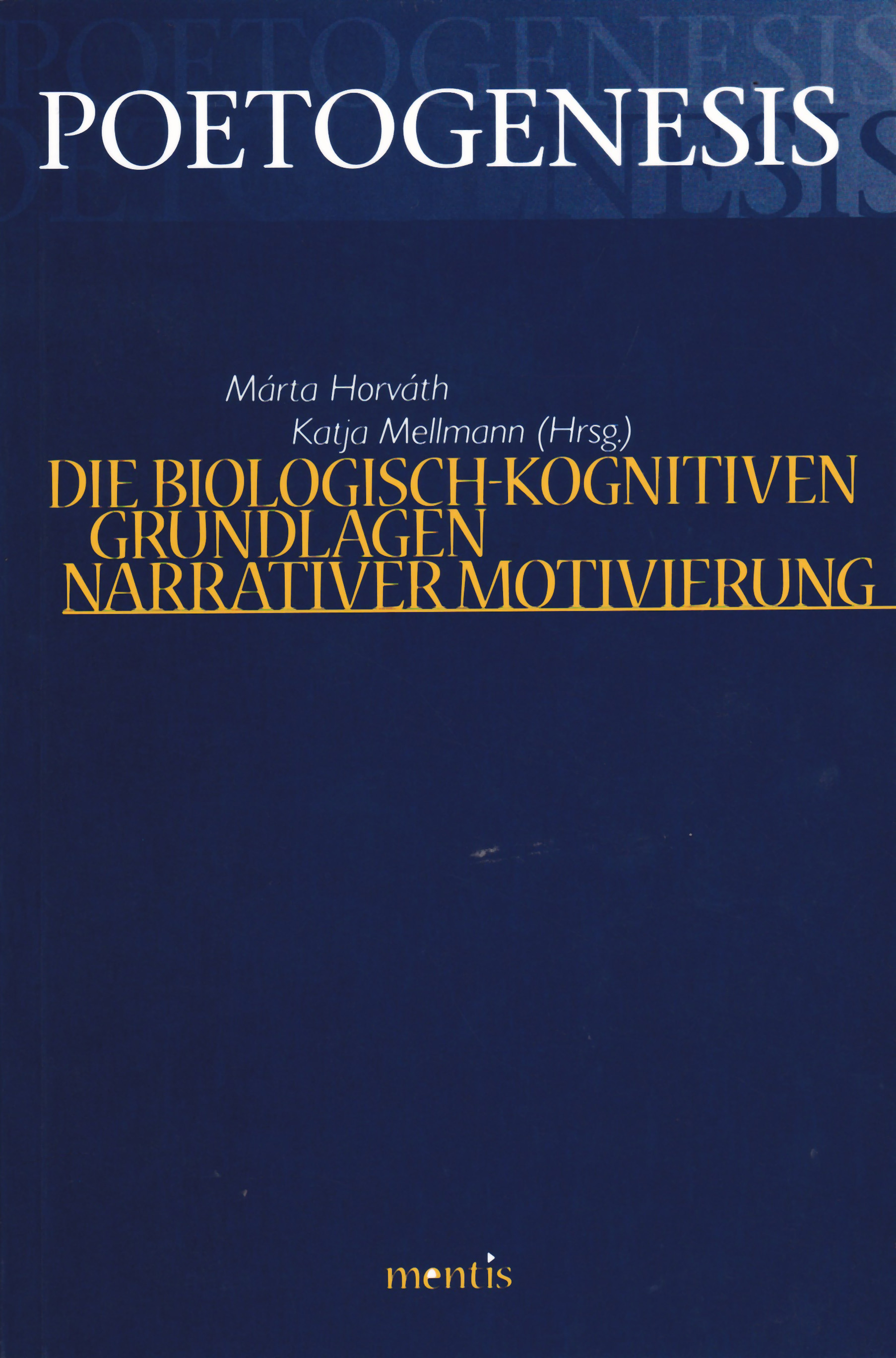
The Biological-Cognitive Foundations of Narrative Motivation.
Conference program
Echo
June 2013
February 2013
2013-2014
The Bio-Cognitive Basis of Narrative Motivation. Bilateral project between the Universities of Szeged and Göttingen, supported by the Alexander von Humboldt Foundation. The project leaders are Dr. habil. Márta Horváth and Dr. habil. Katja Mellmann. Project participants.
Detailed project brochure